For the first time, Meta is projected to surpass Google in global ad revenue: $243.46 billion versus $239.54 billion according to Emarketer projections for 2026. Historic pressure on Google, which responded at Google Marketing Live on May 20 with its densest product release of the year.
In parallel, Meta and Microsoft kept pushing structural updates throughout April. The outcome: six new features stand out across the three platforms; two from Meta, two from Microsoft, two from Google.
The summer challenge isn’t to activate everything at once. It’s to test each relevant feature on a pilot, measure, adjust, so you reach back-to-business with a media plan calibrated on observed results, not product theory. This is where data-driven judgment beats guesswork.
For each of the six features: what changes, a mental picture to grasp it fast, what to test this summer, what to deploy at back-to-business.
What is paid media automation in 2026?
Within paid media, automation means delegating campaign setup, targeting, and optimization to AI systems proprietary to the platforms (Meta, Google, Microsoft, TikTok). The current reality goes well beyond bidding: it now shapes the data sent to platforms, ad creative, audience definition, and visibility measurement across AI responses.
Meta automation: two defaults every paid social marketer must arbitrate
Meta sees first-party data and product catalogs as the same problem: signal quality the platform can no longer trust you to manage well. Both updates below are Meta stepping in.
Conversions API too technical? Meta makes first-party data accessible in one click
The Conversions API was too technical or too costly for your team? Meta removed both barriers in April. One-click setup, no expertise, no maintenance. Meta cites 17.8% lower cost per conversion when the CAPI is correctly implemented, a measurable gain on a metric that drives every campaign decision.
The simple picture. It’s the difference between installing an app and configuring a server. The complexity stays behind the scenes, probably with less first-party data finesse than a custom CAPI, but hidden behind a button. For marketing teams without engineering support, that trade-off is usually worth it.
Recommendation
Good news for SMBs without CAPI. To evaluate cautiously for advertisers already equipped.
- No CAPI? Activate one-click starting in June and baseline your cost per conversion over 6 to 8 weeks before any definitive migration decision at back-to-business.
- Custom CAPI already in place? Run both in parallel on a fraction of traffic and decide in September based on the first-party data granularity and attribution quality gained or lost, a small but real shift in how your measurement is shifting toward server-side.
Advantage+ Catalog: Meta AI fills your storefront on its own. How to keep control
If you run an e-commerce, open Commerce Manager this week. Why? Bram Van der Hallen (Edge.be) spotted it on LinkedIn in April 2026: Meta automatically adds to your Advantage+ catalog the products detected on your site that weren’t there before. Activated by default. Manual opt-out in Commerce Manager.
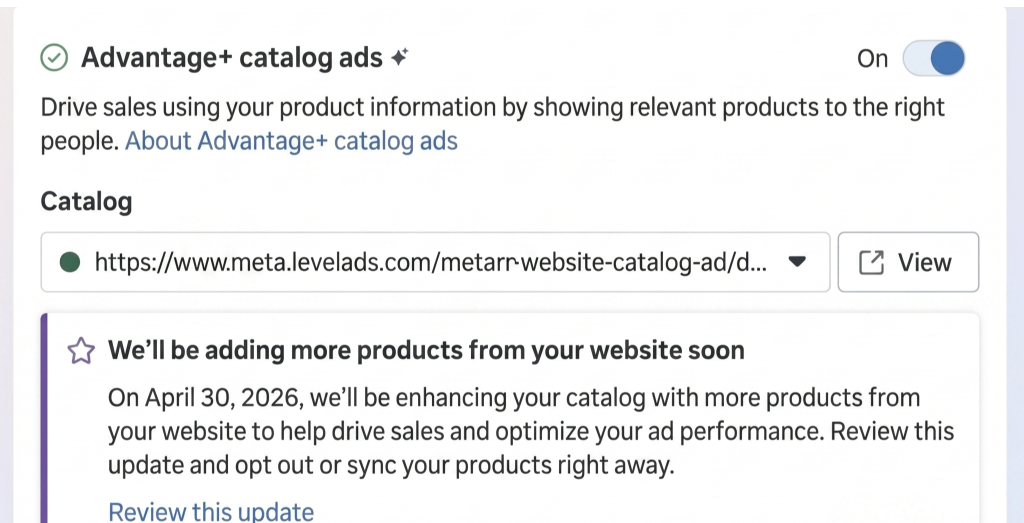
The simple picture. An overzealous salesperson filling your storefront without asking. Good when surfacing forgotten products. Disastrous when dragging the mispriced unsold stock out of the back room, an automation working against your commerce margins instead of for them.
Mohamed Gamal summed up the risk under the post: on a thin-margin e-commerce, an auto-sync of out-of-stock products can destroy POAS overnight. His advice: « Opt out first, review second. »
Recommendation
Opt-out by default on sensitive e-commerce accounts during the summer period (sales, clearance, frequent stockouts).
- Weekly Commerce Manager audit to spot auto-added products and keep control over what stays visible to your target audience.
- More permanent decision at back-to-business: activate with confidence if all your products remain sellable, or maintain opt-out as a rule.
Microsoft in 2026: two AI features to catch the Copilot visibility shift
The cost of waiting on Microsoft this summer isn’t missing a feature, it’s losing the only window where AI Max and Copilot inventory are still cheap, before competitive bidding catches up.
Your ads missing Copilot conversations? AI Max extends visibility across Microsoft’s AI platform
You manage your Search campaigns as if Google and Bing were the only surfaces. That’s changing. Microsoft is launching AI Max for Search. The feature broadens query matching and lets your ads appear directly inside Copilot and Bing conversations, complemented by Offer Highlights, a differentiating argument (« free shipping », « 2-year warranty ») surfaced as a native format inside the response. Constantine von Hoffman sums up the shift in MarTech: visibility moves from ranking and clicks toward selection inside conversational answers.
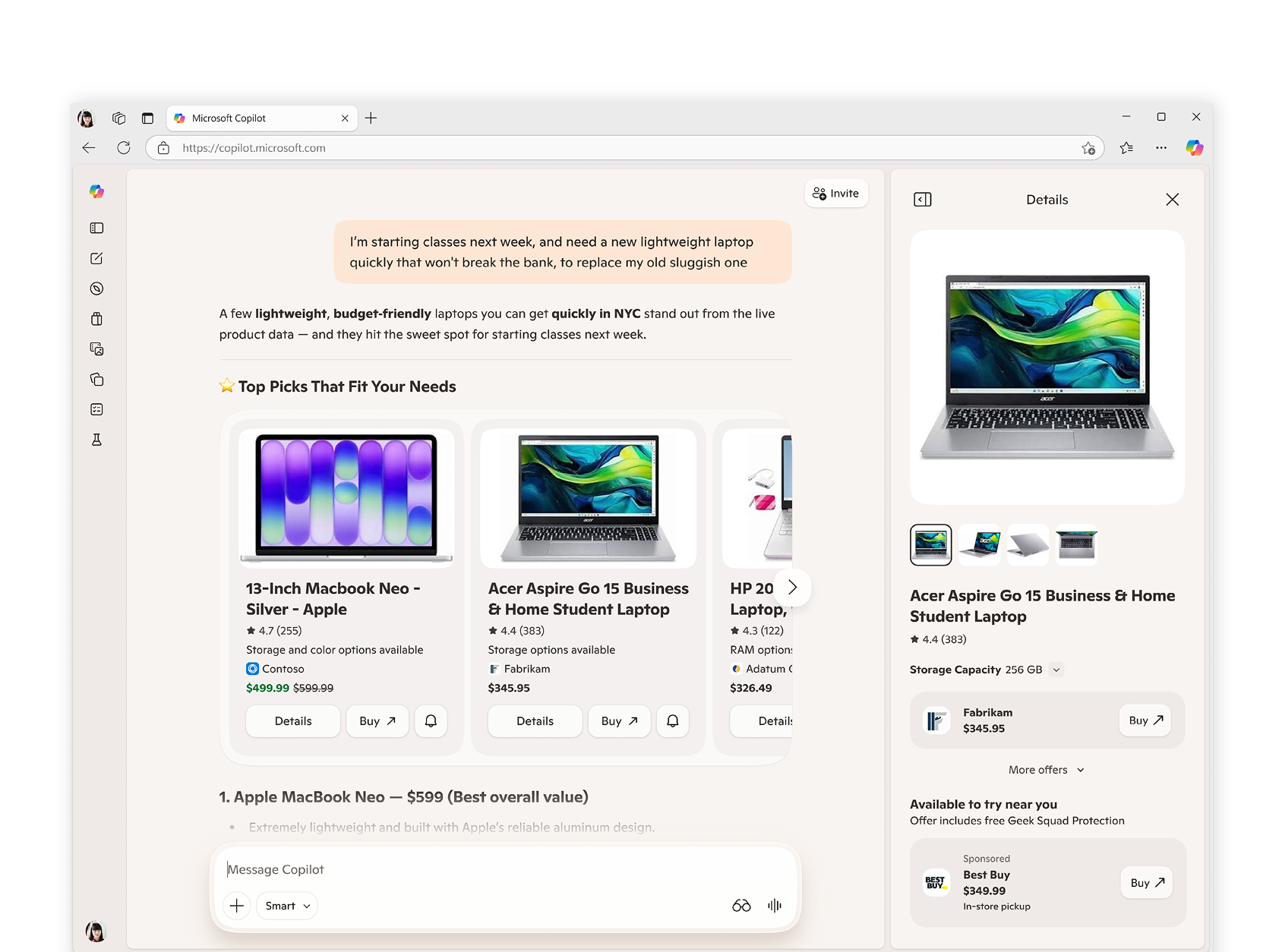
The simple picture. Your ad no longer appears next to the Copilot answer. It appears inside it, a new kind of search engine placement where being selected matters more than ranking, and where your share of voice plays out across channels you didn’t target before.
Recommendation
Pilot open since May. The summer testing window is built for this.
- Activate AI Max on a pilot campaign (5 to 10% of your Microsoft Search ad spend) starting in June and measure search-term reporting and traffic quality over 8 to 10 weeks.
- Decide at back-to-business whether to extend AI Max to the rest of the account, or keep it in pilot mode based on observed, measurable returns and your overall measurement of incremental reach.
Performance Max a black box? NCA and Final URL bring measurement back to advertisers
You’re running Google Ads PMax? You can now test it on Microsoft in a few clicks, with a client case that hits hard. Kevin Salat and his team announced it on the Microsoft Advertising blog: Performance Max campaigns with New Customer Acquisition (NCA) objectives can now be imported from Google Ads. Microsoft cites the ADAC Car Insurance case: nearly 600% ROAS on new customers in the first weeks of NCA.
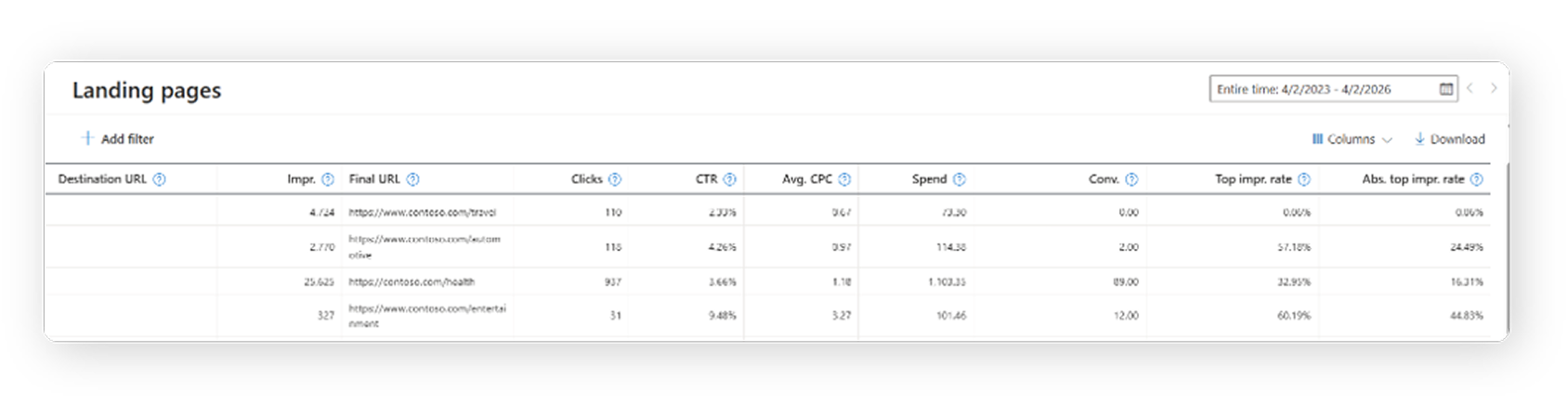
Bonus: Final URL reporting becomes native in PMax, measurable performance by landing page, directly in your campaign view.
The simple picture. NCA means telling PMax « prioritize new customers » instead of letting it cast wide. The import from Google makes side-by-side testing far simpler than before, a rare chance to benchmark the same setup across two platforms.
Recommendation
PMax steps out of the black box. Summer is the window for a cold side-by-side test between Google and Microsoft.
- PMax on Google? Import your NCA campaigns to Microsoft for parallel testing starting in June, and turn on the Final URL columns in your standard reporting and attribution view.
- Decide at back-to-business the budget split between PMax Google vs Microsoft based on the ROI and ROAS observed on new customers.
Google: two AI updates that reshape your Search strategy
Google announced these two updates at the same event for a reason. The asset experiments are the consolation Google offers for tightening AI Mode eligibility, more transparency inside PMax, less choice about whether to run it.
Google locks AI Mode behind AI Max and PMax. Content strategy testing offsets the keyword loss
Two Google announcements from spring 2026 read in chain.
On one side, at Marketing Live on May 20, 2026, Google announced two new ad formats designed for AI Mode:
- Conversational Discovery ads: creative tailored to the user’s specific search, paired with a contextual Gemini explainer.
- Highlighted Answers: ad recommended when AI Mode produces a list-style response (for example « best apps to learn a language »).
Eligibility condition: running on AI Max, PMax, or Broad Match. Exact and phrase setups don’t trigger these placements.
On the other side, on April 20, Google made asset experiments in Performance Max generally available: clean A/B testing between two creative variants (image, video, headline, description) on the same campaign, with statistical winner measurement.
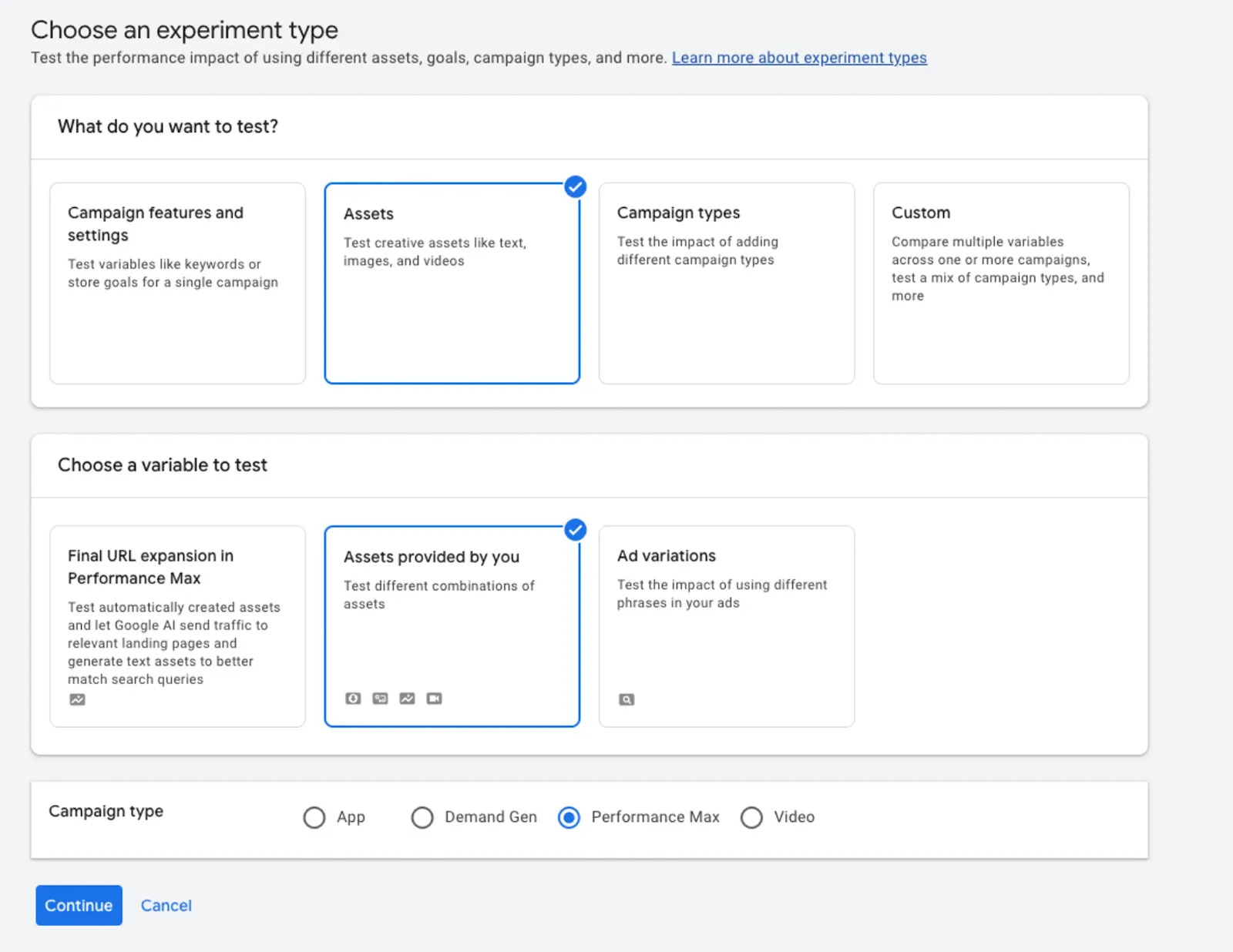
The simple picture. Google is locking Search visibility more and more behind these AI surfaces. Keyword granularity pays the price of the move, but Performance Max steps out of its historic black box at the same time. The trade-off is explicit: less direct control over queries, more control over the creative formats you test and optimise.
Recommendation
The Google topic for the summer: prepare the (at least partial) shift toward AI Max/PMax while setting up the first rigorous asset experiments.
- Create an AI Max or PMax pilot campaign to measure AI Mode visibility versus your current exact/phrase setup, and track your share of voice inside AI-generated answers.
- In parallel, set up 2 to 3 asset experiments on your most mature PMax campaigns to build a content strategy library of validated assets before any large-scale deployment.
- Decide at back-to-business the split between exact/phrase and AI Max/PMax in your Search, calibrated on actually observed visibility and measurable position.
Juggling 4 Google tools? Ask Advisor unifies the measurement ecosystem into a single AI agent
At Google Marketing Live on May 20, Google announced Ask Advisor: a unified AI agent that consolidates Ads Advisor, Analytics Advisor and the upcoming Merchant Center agent into a single conversational interface, with shared memory across tools. You ask a question about a campaign, the agent cross-references Ads + Analytics + Merchant + Marketing Platform data to respond in real-time.
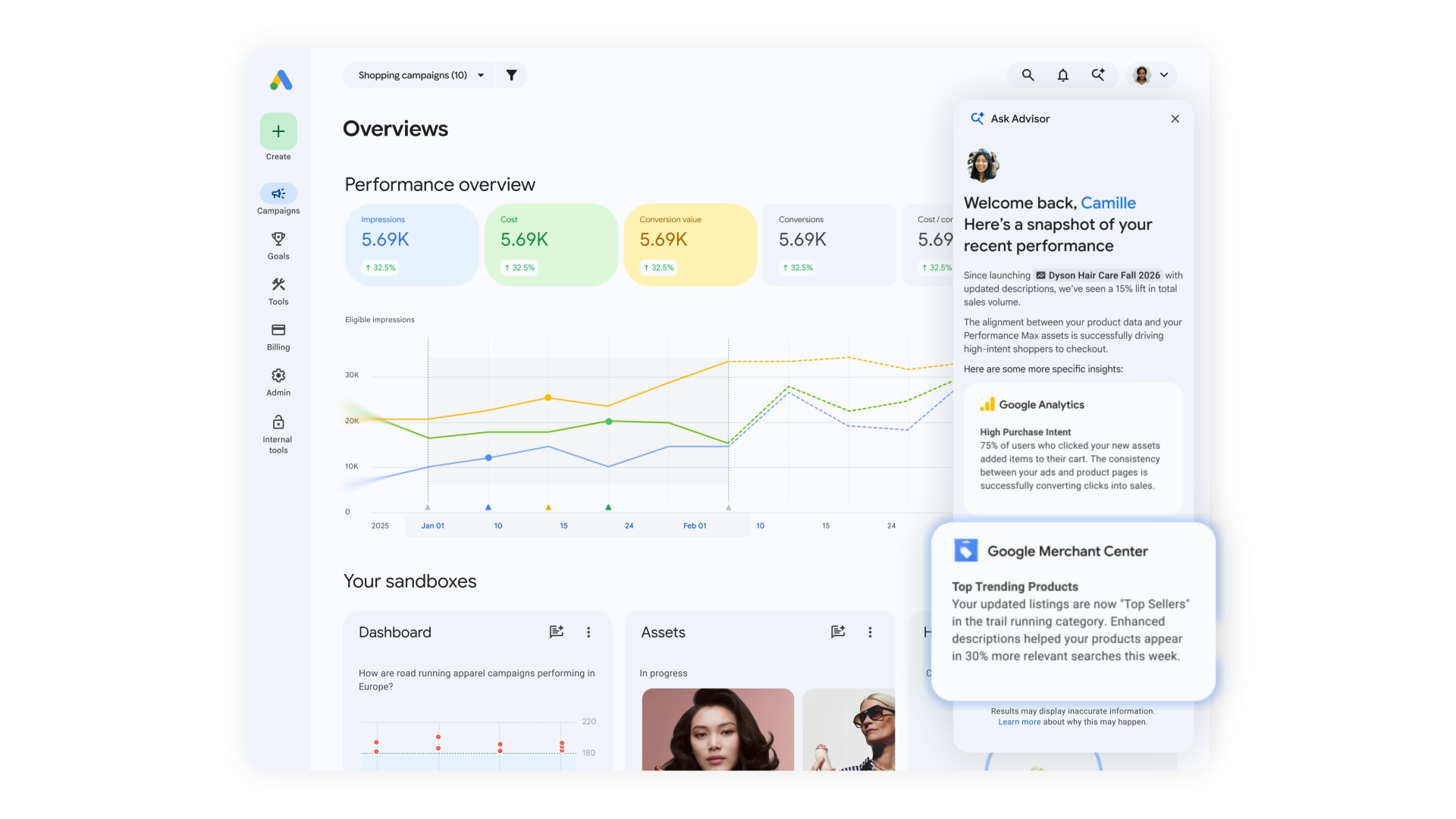
The simple picture. It’s not a new tool, it’s the removal of silos across the whole Google platform. The cross-referencing work you used to do by hand shifts into the agent.
Recommendation
Shared memory across Ads, Analytics and Merchant changes the economics of account monitoring and optimisation. Summer is the right time to get hands-on.
- As soon as access opens on your account, test the diagnostic questions that cost you the most time in cross-tool work (attribution, audience quality, conversion gaps versus your analytics).
- Routinize Ask Advisor workflows in your weekly cadence by back-to-business. The agent partially offsets the complexity that automation introduces elsewhere, a small step toward data-driven account management.
Paid media news: less configuration, more judgment to exercise
Taken separately, these six announcements sound like product noise. Taken together, they describe a deeper movement reshaping the digital marketing landscape.
Less technical expertise to start. One-click CAPI on Meta, cross-platform PMax import on Microsoft, native asset experiments in Google PMax, unified Ask Advisor agent: the entry barrier falls everywhere, and account diagnostics turn conversational.
More automations activated by default. Advantage+ Catalog auto-sync on Meta, query matching expansion on Microsoft AI Max and Google AI Max: opting out becomes the critical move. Before, nothing changed without a click. Now, everything changes unless you click to oppose, a real shift for any marketer used to manual control.
More strategic arbitrage to do upstream. Which assets to test in PMax? Should you accept the loss of keyword granularity to enter AI Mode? At what pace should you migrate from exact/phrase to AI Max? These data-driven questions weren’t being asked six months ago.
Paid media in 2026 demands less configuration. But more judgment. Summer 2026 is precisely the window to exercise that judgment in cold blood, on calibrated pilots, before back-to-business imposes decisions under budget pressure, while the platforms increasingly decide by default.
Why partner with a paid media agency in 2026
When automation takes over the setup, the instinct is to skip the middleman. The reality we observe with our clients is the opposite: the more platforms simplify configuration, the more they shift the effort toward strategic arbitrage that no algorithm will do for you. And summer 2026, the testing window before back-to-business, is precisely the moment when the role of an agency becomes most visible. Three specific reasons.
Reason #1. Which platforms and features belong in your account roadmap?
You have a budget to split across Meta, Google, Microsoft, TikTok and the new surfaces — CTV, ChatGPT Ads, Perplexity Ads. Each optimises for its own objectives, not necessarily yours. Add roughly twenty product evolutions a month to arbitrate, a pace no single marketing team can track alone.
The agency plays two arbitrages that chain together. First, seeing where your marketing investments work best across a portfolio of accounts, a cross-sector benchmark impossible from a single one. Second, turning each announcement into a decision: « Google opens AI Mode to AI Max advertisers » is information; « shift 20% of your Search budget to AI Max over July-August, clear return expected by September 30 » is a decision.
At blue2purple, we arbitrate this allocation across B2B and B2C clients in parallel, factoring in the paid and organic mix, often underestimated, though it can weigh as much on the purchase decision as all digital channels combined.
Reason #2. Who monitors your PPC metrics and tests new features for you?
Advantage+ Catalog auto-sync adds products by default. AI Max for Search opens its pilot in May. PMax asset experiments demand a rigorous testing protocol. And in September, several Google features automatically migrate to AI Max. None is bad but none should run unsupervised.
Monitoring isn’t enough: you also have to test. Your internal team tests on your own campaigns; an agency tests in parallel across ten accounts of different typologies, benchmarking results across channels. Field feedback arrives faster, more robust, and reveals side effects no isolated account would show.
When a client asks us « should we switch the entire account to AI Max before back-to-business? », the answer isn’t an opinion, it’s data-driven, drawn from comparable accounts.
An agency centralises notifications, audits and tests, and documents what works by vertical.
Reason #3. Your AI automations producing noise on messy first-party data?
Activating a new AI feature on messy data is like buying a race car to drive on a broken road. AI Max builds with what you have, not with what you think you have. PMax asset experiments only give a reliable result on clean product feeds and exact conversion tags. Data discipline — tracking audit, customer list structuring, dynamic labeling, product feed review — is what separates automation that produces results from automation that produces noise.
Paid media automation in 2026 doesn’t replace strategic judgment. It makes it harder to exercise. And more costly to exercise alone.
FAQ
Most paid media FAQs answer what a feature does. These answer when a feature is worth your team’s time.
How do you build an effective 8-week paid media testing protocol this summer?
The empirical rule: 4 to 6 weeks of data per variant for reliable, statistically measurable signals, plus 2 weeks of reading-decision. Hence an ideal testing window that starts in early June for a clear decision by mid-August.
Three principles.
One: one test = one variable at a time (asset OR audience OR budget split, not everything at once, otherwise you won’t know what moved). Two: a sufficient budget sample, 10 to 20% of your ad spend over the period, no less, otherwise you’re measuring noise instead of a real metric. Three: a written, data-driven protocol from the start — hypothesis, success metric, decision threshold. The same discipline applies across all your digital channels. Without it, the test becomes an opinion, not a repeatable part of your digital marketing strategies.
Which paid media features should you prioritize for testing this summer when budget is limited?
Three criteria. First: the feature activates by default on your account (you have to decide either way — Advantage+ Catalog auto-sync falls into this bucket). Second: the feature touches a channel that represents more than 20% of your current ad spend. Third: a measurable client case is documented, with clear metrics.
Across the six spring 2026 features, four tick all three boxes for most accounts: Meta Advantage+ Catalog auto-sync (default activated), Microsoft PMax NCA (ADAC case at nearly 600% ROAS), Microsoft AI Max for Search (pilot open from May), and the Google AI Mode / PMax asset experiments duo (GA for all, and now conditions eligibility across Google AI placements).
The other two deserve a pilot test depending on account maturity and your wider digital marketing strategies, not a full-scale activation as soon as the summer.
Should you migrate all your Search campaigns to AI Max before back-to-business?
No, not in one block, and not before testing. Google will auto-upgrade Dynamic Search Ads to AI Max at back-to-business, but that doesn’t mean your entire account should migrate. AI Max has an explicit trade-off: less keyword granularity in exchange for AI Mode visibility and long queries.
If your business depends on ultra-targeted, high-intent search terms (niche B2B, local services with restricted zones), keep exact/phrase on those queries. If your business depends on broad discovery and long queries, migrate.
Most optimal post-back-to-business 2026 accounts will be hybrid, not full-AI Max, not full-exact, a position calibrated on measurable returns.
How do you know if your internal team can handle summer testing + back-to-business 2026 alone?
Three signals. One: you run on more than two platforms (Meta, Google, Microsoft, TikTok…), no internal team of 1-3 people can master all product releases across channels in parallel. Two: you discover the new features several weeks late, after your peers — did spring 2026 catch you off guard? Three: you don’t have time to set up structured pilots this summer, you’re planning to « test in production » by back-to-business.
Two signals out of three? The cost of an agency is probably lower than the cost of missed opportunities in a fast-moving digital landscape.
Conclusion
The platforms simplified what used to require an engineer. They didn’t simplify what requires a decision. Choosing which 20% of budget to shift, which automation to opt out of, which keyword granularity to defend, those arbitrages get harder as the defaults get more aggressive.
Summer is the only quiet window left to make those calls in cold blood. By back-to-business, the AI defaults will already be running on your account, and the cost of a wrong arbitrage compounds for an entire quarter.
Want to stress-test your back-to-business 2026 plan? Let’s optimize your paid media strategy together →
Sources
- Anu Adegbola, Meta is on track to overtake Google in global ad revenue for the first time, Search Engine Land, April 14, 2026.
- Jon Loomer, One-Click Conversions API, Pixel Updates, and More, Jon Loomer Digital, April 16, 2026.
- Bram Van der Hallen, LinkedIn post on Advantage+ Catalog auto-sync, LinkedIn, April 2026.
- Constantine von Hoffman, Microsoft updates ads platform for AI-driven discovery, MarTech, April 21, 2026.
- Kevin Salat, Eugene Goldenshteyn, Linda Shi, Performance Max updates and other product news for April 2026, Microsoft Advertising blog, April 16, 2026.
- Tim Frank, Win across all three eras of the web, Microsoft Advertising blog, April 21, 2026.
- Google Ads, Asset experiments are coming to Performance Max, Google Ads product announcements, April 20, 2026.
- PPC Land team, Google Marketing Live 2026: every announcement that actually matters, PPC Land, May 21, 2026.
Overview